Tuesday, July 18, 2023

SPACE DETECTIVE: A novel excerpt


I set up the distribution for Space Detective to avoid limiting access to just Amazon and/or Barnes & Noble, so readers could procure it from their preferred online dealer, whether for a paperback or an ebook edition. Even libraries and retail brick-and-mortar stores can order and put this book on their shelves.

However, the teaser preview that online retailers provide differs according to the site you visit. Amazon appears to offer the longest preview. Other retailers, none at all.

So I’m posting an extended excerpt so everyone can have a look, no matter where you choose to shop.

You'll find it at my writer's site by clicking here.

Wednesday, December 29, 2021

Review: THE ARSENAL OF WONDERS by Dwight Decker

If you grew up reading primarily DC Comics during the Silver Age (National Periodical Publications in those days, rather than DC; I’m focusing on the 1960s when I say Silver Age), you were accustomed to a far different sort of comic book storytelling than we’re seeing nowadays in what I’ll call, for simplicity’s sake, the Graphic Novel era. (I’ll posit that this era has many overlapping names and motifs, but the lowest common denominator seems to be long-form storytelling, thus graphic novel.)

In most cases those days a complete story would’ve been published in a single issue. Likewise, a single issue might’ve included a primary, cover-featured story plus a back-up story: a shorter tale and likely starring a second-string hero. Detective Comics is a good example, because many issues used Batman in the lead and usually Elongated Man—but sometimes Batgirl—in the back up.


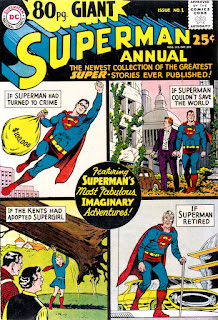
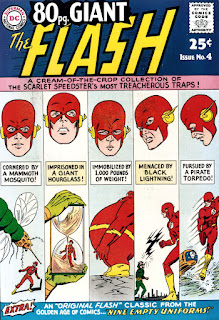
You would’ve been familiar with the 80-page Giant issues, which were priced 25 cents and compiled stories from the past and typically focused on a single theme. For example, I recall a Superman Giant issue whose stories focused on the different colors of kryptonite; a Jimmy Olsen Giant issue featured several of the strange transformations Superman’s pal had undergone over the years. (I won’t go into those changes, but you can click here for an article that describes 15 of those stories—and it’s absolutely appropriate that the word bonkers is in the essay title. Gregor Samsa never had so much fun, but Jimmy Olsen never experienced much existential angst before the reader reached the letters column.)

This rambling preamble boils down to a simple statement: These Silver Age comics were intended to be fun and had little to do with the real world (except occasionally: Jimmy Olsen infiltrated a gang of juvenile delinquents and learned Perry White’s son was a member in "Jimmy Olsen, Juvenile Delinquent!"; it appeared in the October 1959 issue of Jimmy’s comic). The superhero stories were diverting tales focused on good guys battling bad guys and often incorporated elements lifted from pulp science fiction magazines.

If the sharp swerve into noirish (nightmarish?) superheroics initiated by Frank Miller’s Batman: The Dark Knight in 1986 was preceded by a long transition period launched with Denny O’Neil and Neal Adams’ grittier takes on Batman and the socially conscious/relative Green Lantern/Green Arrow team-up starting in 1970, we can perhaps describe the Silver Age DC era as a pastoral superhero age.

This latter world is the sort of setting that anchors Dwight Decker’s novel The Arsenal of Wonders. (It’s worth noting the book’s title echoes that of The Arsenal of Miracles, a 1964 SF novel by Gardner F. Fox, one of DC’s most prolific scripters during both the Golden Age and the Silver Age.) Using tropes familiar to fans of the Silver Age, Decker builds a universe about a superhero who is displaced in time and in space.

Decker introduced Astroman, the hero of this book, in a prior novel, The Secret Citadel. Matt Dawson was thrown into a parallel Earth thanks to a lab experiment gone awry. This new Earth is very like Matt’s own except that it’s 1967 and superheroes and supervillains are among those who populate the world. Matt gains some powers of his own because of his dimensional transition.

In this novel, Matt and Astrogirl travel through space and time to visit Helionn, the planet from which Astrogirl and Astroman came to Earth. They must go back in time to visit the planet because it exploded years ago.

They travel to Helionn to find a legendary arsenal that will help them battle an arch foe, Garth Bolton, whose crime spree is expanding as it exploits the disappearance of Astroman.

If this sounds familiar—like the origin story of Superman and the fodder for many Silver Age tales in which Kal El visited Krypton or viewed scenes from its past—then understand that Decker is writing homage. This novel is an extended letter of thanks and loving respect to all those creators who built, story by story, the remarkably rich universe the Silver Age heroes inhabited before it was exploded—quite literally—by the Crisis on Infinite Earths (presented in a 12-issue series published in 1985 and ’86) and subsequent Crises and . . . assorted other continuity-busting reboots (by whatever names) that successively dilute the iconic legends established during the Silver Age and based on the Golden Age versions of those heroes and stories.

As homage, this is not an explosion-illuminated tale cuing up life-or-death battles in every other scene: in other words, this is not comparable in any way to a movie in the Marvel Cinematic Universe. Just as it took decades for the details of Superman’s canon to accrete to the Man of Steel—Smallville, Krypto, the many colors of kryptonite and its multifarious radiations, the Fortress of Solitude, Kandor the bottled city, Lori Lemaris, Jimmy Olsen’s signal watch, Supergirl, the Legion of Super-Heroes, and on and on—Decker’s tale is a more leisurely stroll through the inventories of SF tropes used in countless sword-and-planet and space opera novels and stories from the time of Edgar Rice Burroughs’ A Princess of Mars (1912) through the 1960s—and beyond, really, if you consider how Star Wars was influenced by pulp fiction and Hollywood serials.


If you occasionally are swept by nostalgia for a simpler era of comic book storytelling, for heroes untainted by shades of gray and who knew good from bad—for heroes who were heroic—you may enjoy The Arsenal of Wonders. Reading it is an experience much like that of Matt Dawson: a trip through time and space.

It's available from Amazon at this link.

Sunday, February 14, 2021

Indie review: Tyche's Flight by Richard Parry


Parry, Richard.  Tyche's Flight: A Space Opera Adventure Science Fiction Epic (Ezeroc Wars Book 1)

This review is about a science fiction novel titled Tyche’sFlight. Why I’m writing it is covered in the Introduction, which follows. But if you just want to read the review, feel free to skip the Introduction.

Introduction

In the late 1960s and into the 1970s, Hollywood’s Big Studio system began to collapse under its own weight and changing fashions as the French film fashion of auteur worship spread and young renegades and small, independent producers began more and more to scrounge together funding and make films on a shoestring budget that made money at the box office.

Something similar started happening in mainstream publishing not long after, as publishing houses began growing by acquiring other houses, so that nowadays what was once a stand-alone publisher is now just an imprint of a larger international conglomerate, and a publisher’s name is now a string of names separated by slashes or hyphens. Here are just two examples to illustrate the corporate complexity common to mainstream publishers:

·         Hachette Book Group imprints: Hachette Books (formerly Hyperion Books, acquired in 2013), Little, Brown and Company (bought by Time Inc. in 1968), Grand Central Publishing (formerly Warner Books, which was part of Time Warner Publishing, which had bought MacDonald & Co. in 1992, Popular Library in 1982, and Paperback Library in 1970), Yen Press, FaithWords, Center Street Books, Windblown Media, Perseus Books (acquired 2014), DaKapo Press, Basic Books, Seal Press, Orbit

·         Penguin-Random House imprints: Penguin, Random House, Vintage Books, Crown Publishing Group, Modern Library, Bantam, Ballantine, Del Rey Books, The Dial Press, Knopf Doubleday (remember when they were separate businesses?), and more

All this acquiring and conglomerating meant, in some cases, economies of scale could be achieved. In other cases, it meant a loss of smaller companies’ editorial idiosyncrasies as the larger corporations’ expectations percolated through the editorial and marketing and acquisition departments.

It also meant a greater dependence on big sellers. Mid-list writers found it harder to gain or maintain a toehold, and their books eventually went out of print.

Fortunately, improvements in Print On Demand technology and the rise of small and independent publishers—usually focused on a single or two genres—and the ease of self-publishing have led to an explosion of books being published and easily available outside the traditional mainstream publishers’ catalogs.

This is a good thing.

Unfortunately, there’s so much to choose from, it’s sometimes difficult to know what to read next, unless you happen to know the author or have a reliable word-of-mouth network. Have you ever gone to the grocery for bath soap only to discover one entire aisle of the store is devoted to different brands and types of bath soap? It’s kinda like that.

Marketing is important for getting your books noticed. But marketing can be an expensive proposition—in time and money—which is valuable for indie writers and publishers: if they’re spending their time marketing their books, they’re not writing and producing the next book; and if that next book doesn’t exist, no readers can buy it, which makes balancing the writer’s budget an even harder job.

There are a few scattered blogs that review indie books, but tracking them down isn’t always easy, and their approach may be scattershot.

So, to support indie writers’ efforts, I started this year with the intention of reading more indie books. (I didn’t make a New Year’s Resolution—“resolve” sounds very formal, and that makes me twitch a little. Also, resolutions have a reputation for being broken. So I’ll stick with intention. Much more casual-sounding word.) I’ll also write some reviews for these books. Some will be for books by my pals. Some will be for books I don’t know anything about, but thought I’d just jump in and try ‘em. This first indie review, for Tyche’s Flight, is in that latter category.

 The Review

Tyche’s Flight is the first in at least two Space Opera trilogies - part of a larger story cycle, the Ezeroc Wars - about the ship and its crew. It’s Space Opera of the sort for those who like the Firefly TV series. If you like the camaraderie of the Rocinante’s crew in The Expanse novels without the macropolitical and socio-cultural discursions, you’ll like Tyche’s Flight. If you like the action in Jack Campbell’s Lost Fleet novels, you’ll probably enjoy this book.

Grace Gushikenis on the run. She is an esper, a creation of the Empire—now known in the Republic as the Old Empire—and her kind are hunted down and destroyed. So Grace is on the grift, running cons to get from one planet to the next so she can stay at least one step ahead of the Republic’s Men In Black. Her efforts lead her to insinuate herself onto the crew of Tyche, an independent cargo runner. (Think the Star Wars’ Millennium Falcon with a captain--Nathan Chevell—a little less rogue-ish but just as headstrong as Han Solo.

Author Richard Parry doesn’t counterfeit characters from other series, but they are recognizable types. And the characters are interesting and likeable. The Tyche’s crew includes Hope, a young but highly competent engineer who keeps the Tyche running, and who has a secret that’s keeping her hiding from the Republic, just like Grace is. But the rest of the crew knows Hope’s secret. Grace is a newcomer, and hasn't yet earned the level of trust that will let them share that sort of family secret Grace doesn’t let anyone in on her reasons for running.

Elspeth Roussel—El to the rest of the crew—is a top-notch (of course) pilot who zigs and zags and punches it whenever the need arises for Tyche to evade or escape or rush into harm’s way.

October Kohl is both muscle and juggernaut. When there’s a fight, he’s first in line for the fun. (It’s also likely that he started it.) Think Amos Burton (from The Expanse) with a shorter fuse and a great capacity for holding a grudge. He's not simply a two-dimensional character, and his skill at being in the center of dust ups means he has a strong cadre of fans among Parry's readership.

Tyche’s Flight explores the dynamics of this crew’s relationships—among each other and with the greater universe around them—as they learn Grace’s secrets and as she learns theirs. The plot focuses on the Tyche’s mission: the Republic hires the crew to deliver a replacement to a distant star gate that’s stopped working and whose station has gone silent.

Perfect set up for bad stuff to happen.

Parry creates tension and real thrills—not just when Tyche reaches its destination, but along the way. Hope demonstrates that she’s indeed a crackerjack engineer, saving the ship and her crewmates more than once. Grace’s esper abilities—though abhorred by everyone around her—allow the crew to discover the secret behind the threat once they reach the disabled star gate. (The Bugs from the film version of Heinlein's Starship Troopers are probably a distant cousin to these villains.)

If you like the alien mysteries and space battles that push the narrative in Jack Campbell’s Lost Fleet books, you’ll find plenty of elements in Tyche’s Flight to enjoy.

This story stands alone as an enjoyable SF adventure. It also opens up possibilities for the subsequent novels. The characters are interesting. The incidents are entertaining, and the action is engaging. I’ll be reading the next book in the series, Tyche’s Deceit.

Book: https://www.amazon.com/gp/product/0995104107/ref=as_li_qf_asin_il_tl?ie=UTF8&tag=thepulprack-20&creative=9325&linkCode=as2&creativeASIN=0995104107&linkId=6eb786de50d1b5b507554a10a38251b2

 Kindle Ebook:

https://www.amazon.com/gp/product/B0765SS25V/ref=as_li_qf_asin_il_tl?ie=UTF8&tag=thepulprack-20&creative=9325&linkCode=as2&creativeASIN=B0765SS25V&linkId=1c379dfb37fba1ea99367ee0d081a8cf


Sunday, January 12, 2020

The Cincinnati Kid by Richard Jessup


An excellent tale about humans testing their limits and their human qualities. That sounds like a stretch for a story about stud poker, but Jessup does it well in this short novel. Because while the story appears to be about poker, really it’s about the Kid of the title. It’s like the description of a cigarette someone once gave me: smoking itself—whether for satisfying an oral fixation or looking cool or whatever—isn’t really the object of putting fire to a cigarette and inhaling the fumes from its immolation; instead, a cigarette is actually just a transport device for nicotine. In this case, the novel—The Cincinnati Kid—uses poker to show the reader who the Kid really is.

This is only the second novel by Jessup I’ve read. The first—a western titled Wyoming Jones—isn’t nearly as good as this story. It’s essentially a pulp western featuring some hardcases driving a plot to its conclusion. The Cincinnati Kid is an honestly hard-boiled novel about people maneuvering to control the events in their lives. The tone is consistent and believable from start to finish. Whether Jessup’s writing improved between 1958 (Wyoming Jones) and 1963 (The Cincinnati Kid) or he could handle contemporary settings better than westerns, I can’t say. Maybe the latter is more on target, for Ed Gorman (whose discerning eye for writing I’m willing to trust) has stated about Jessup’s pre-western writing,

We first see Jessup in the early `50s when Gold Medal was promoting him as their own angry young man. The books were thick and dealt with social themes such as race and juvenile delinquency. I haven't read them in years but I remember liking them.

Or perhaps Jessup was sufficiently inspired and influenced by Walter Tevis’ The Hustler (for like Tevis' Fast Eddie, the Kid is a young gun who challenges the top player in his field) to sustain the proper voice throughout the novel. 

There's honesty and reality in that voice. Jessup relies on some of his own history to flesh out the laconic Kid: according to a 2017 article from The Poker News, Jessup spent time working as a dealer in a Harlem gambling joint, which allowed him to play with the professional card-players’ jargon so believably in the novel. Further, there’s the sense of emptiness in the Kid’s background. Jessup spent his youth growing up in orphanages, and the reader’s realization that the Kid’s quest--at least part of that quest--throughout the tale is to build a family may come after turning the last page. It’s evident in how he relates to the other card players in his circuit, especially to his mentor, The Shooter; in how he reacts to the departure of “his woman,” Christian Craigie, and how he talks with her afterwards.


As an aside, I was surprised that this novel—which takes place nearly entirely in St. Louis—veers off to the Ozarks near its midpoint, predating Daniel Woodrell’s remarkable narratives set in the Ozarks; but the Kid’s adventures there are quite different from the sorts of tales Woodrell’s characters live out in those hard-scrabble backwaters.

Jessup handles all these elements masterfully, never showing off to appear “literary,” but telling his tale in its pared-down style and disguising it as just a genre novel. The scenes of the poker match between the Kid and Lancey—“The Man”—are marvelously handled and Jessup builds tension in this stretch of prose seemingly effortlessly. (If all you know is Texas Hold'em, you owe it to yourself to read this and learn about stud poker.) By the end of the tale, Jessup has allowed the reader to see the depth of the Kid’s character without ever pointing it out explicitly. He does this so well, it’s quite possible the reader knows more about the Kid’s values than the Kid may know about himself.

It’s really an excellent novel. It’s short, too, so you can probably read it in a day or over a weekend. I recommend it.

Maybe now I’ll watch the Steve McQueen movie.


Saturday, September 26, 2015

Tex Rickard, boxing promoter

George Lewis Rickard, known as Tex, died January 6, 1959—four days after his 59th birthday.
He was a true entrepreneur. He launched the New York Rangers franchise of the National Hockey League in 1926. He owned the team until his death.

Tex was the primary force behind building the third incarnation of Madison Square Garden in 1925. It was located at Eighth Avenue between 49th and 50th Streets in Manhattan.

Rickard was an innovator. Between 1921 and 1927, Tex raised the popularity of boxing by promoting a number of fights for “The Manassa Mauler,” world heavyweight champion Jack Dempsey. For the Dempsey-Charles Carpentier bout in 1921, Tex was responsible for the first live radio broadcast of a title fight and the first million-dollar fight.

Tex promoted the July 4, 1910 Fight Of The Century in Reno, Nevada, between former heavyweight champion and “Great White Hope” Jim Jeffries and reigning heavyweight Jack Johnson. 15,760 fans paid $270,775 to watch the bout. Tex sold the film rights to the match for $101,000.
In 1906, while running a saloon in Goldfield, Nevada, Tex organized the first boxing matches in that state.

After moving to Alaska in 1895 during the Gold Rush, Tex earned and lost several fortunes. As owner of The Northern Saloon in Nome, he befriended famous lawman and gunman Wyatt Earp. And in 1900, he met down-on-his-luck bareknuckle boxer Jean St. Vrain—an encounter that would lead to a very different sort of fight.

You can read about the results of their meeting in FIGHTING ALASKA, a Fight Card book, now in paperback, by clicking here.

Saturday, July 4, 2015

Pre-publication review for AIRSHIP HUNTERS

Writing partner Jim Beard and I are very pleased to let you know AIRSHIP HUNTERS has received a very nice pre-publication review from Dave Brzeski. You can visit Dave's British Fantasy Society site and read his review by clicking here or by using the following URL:

http://www.britishfantasysociety.org/reviews/airship-hunters-by-jim-beard-and-duane-spurlock-book-review/

Meanwhile, Meteor House reports that the deadline for pre-orders has been extended to July 13! Check out the details by clicking here.

Friday, June 19, 2015

Interview on PulpCrazy blog

Jason Aiken is the brain behind a blog-and-podcast combo, PulpCrazy. He posts reviews, interviews, and all sorts of pulp-related items sure to interest fans of fun, exciting speculative fiction.

Jason recently posted an interview he conducted with Jim Beard and me about our soon-to-be-published novel, Airship Hunters. He did a nice job of asking the right questions. The book will be released at PulpFest in Columbus, Ohio. Here's the promotional copy for the book:

<<
A thrilling novel of turn-of-the-century intrigue and mystery!
It is 1897 and the skies are haunted by mysterious airships and unfathomable secrets.


Tasked with hunting down these strange vehicles of the air and determining their origin and intent, two U.S. government agents toil under unusual conditions to supply their shadowy superiors with information. But that information proves to be as elusive as the airships themselves.

Ride with Agents Valiantine and Cabot across the Midwest as they encounter reports of strange lights, phantom soldiers, unreliable witnesses, and the ultimate source of their airborne prey.

They are the Airship Hunters, and they cannot be waylaid from their path to uncover the greatest mystery of them all.
>>

 PulpFest is scheduled for August 13-16. It is a very enjoyable convention focused on pop culture--particularly the pulp magazines that thrived as the primary form of mass entertainment from the end of the 19th century until the middle of the 20th century, and served as the birthplace of some remarkable characters: Tarzan and John Carter, Sam Spade and the Continental Op, Elmore Leonard's western heroes, Mickey Spillane's tough guys, Louis L'Amour's western characters, Robert Heinlein's Starship Troopers, A.E. van Vogt's Black Destroyer (the inspiration for Ridley Scott's Alien), John W. Campbell Jr.'s Thing From Another World (the basis for John Carpenter's Thing), and more.

Remember, Airship Hunters will be released as a limited edition! By pre-ordering by July 1, you will receive a signed copy and your name will appear in the Acknowledgments. Please note: The number of copies printed of Airship Hunters will be determined by the number of pre-orders. The book will be published this summer. Only a small number of copies will be printed beyond the number pre-ordered. What this means: the only way to guarantee you'll get a copy of this book is to pre-order it. You can do that at the Meteor House Press site by clicking here.

Thanks for your patronage! Enjoy Jason Aiken's interview with Jim and I by clicking here.

Monday, June 1, 2015

Essay on Fighting Alaska at Venture Galleries

Paul Bishop, number one gym rat and fitness trainer at the Fight Card series of books and a talented author, has graciously posted my essay on writing my Fight Card entry, Fighting Alaska, "Fighting Alaska with Gold, Greed, and Gamblers," at the Venture Galleries. Venture Galleries is a "marketing and publishing house that showcases, promotes, and markets the works of talented Indie authors and artists who are building a niche in the marketplace." You can find the essay by clicking here. And many thanks to Paul.

The eBook edition of Fighting Alaska is available at Amazon. I anticipate the print edition to swing into existence in the coming weeks. I'll post here when the print edition is also available.

Many thanks for your patronage!

Thursday, May 14, 2015

Now available: FIGHTING ALASKA, the eBook version

My entry in the Fight Card series, Fighting Alaska, is now available as an eBook at Amazon. You can find it by clicking here.

You can also find my article on writing Fighting Alaska, "A Fighter's Trail to the Alaskan Gold Rush," at the Fight Card site. Read the article to find out why Charles Bronson's photo is included with this post. Click here to visit the site and see the article.

For those who prefer paper and ink over Kindle pages, the print version should be available soon.

Tuesday, May 12, 2015

Coming this week: Fighting Alaska

I join the ranks of the Fight Card writing stable with the upcoming publication of Fight Card: Fighting Alaska. I'm looking forward to this release. It will appear first as an eBook, and the print version will follow soon after. The cover is by Carl Yonder.

The Fight Card series of books works this way: the eBooks are published under the house name, Jack Tunney. The subsequent print versions appear with the authors' actual names.

The Fight Card series was launched by authors Paul Bishop and Mel Odom and was "inspired by the fight pulps of the ’30s and ’40s – such as Fight Stories Magazine – and Robert E. Howard’s two-fisted boxing tales featuring Sailor Steve Costigan."

Many of the stories are set in the boxing milieu of the 1930s and '40s. However, there are stories set outside those confines. For example, one series of tales within the Fight Card ring feature Sherlock Holmes in boxing-related mysteries. My entry, Fighting Alaska, occurs during the turn of the 19th Century to the 20th. Here's the promotional blurb:

1900 Alaska … Gold, greed, and gamblers – a dangerous combination in a gold rush boomtown. Itinerant boxer Jean St. Vrain has a lifetime of rootless wandering behind him and ten years of knuckle-busting boxing, bar bouncing, and disillusionment. He wants to call quits to the fight game, but he needs a way out. Joining a mob of desperate men heading for the Alaskan gold fields, Jean is caught between crooked judges, crooked businessmen, a soiled dove, and infamous gunman Wyatt Earp and his cronies. With his future looking as harsh as the Alaskan landscape, Jean has one chance left – fight again.

Tuesday, November 11, 2014

Writers and baseball pitchers

"In Billy Beane's mind, pitchers were nothing like high-performance sports cars, or thoroughbred racehorses, or any other metaphor that implied a cool, inbuilt superiority. They were more like writers. Like writers, pitchers initiated action, and set the tone for their games. They had all sorts of ways of achieving their effects and they needed to be judged by those effects, rather than by their outward appearance, or their technique. To place a premium on velocity for its own sake was like placing a premium on a big vocabulary for its own sake. To say all pitchers should pitch like Nolan Ryan was as absurd as insisting that all writers should write like John Updike."

MONEYBALL, by Michael Lewis.

Moneyball is available at Amazon.com . . .

, , , and hey, look, it's a Brad Pitt movie, too! And shockingly, Hollywood kept the title: Moneyball.

Friday, October 25, 2013

Friday doodle

Time for another Friday doodle. (I know, I know, it's nearly Saturday before I got it posted.)

This one executed with that underappreciated artist's tool, the ball point pen.

Enjoy.

Thursday, October 3, 2013

Friday Doodle

I know it's Thursday evening as I post this, but by doing so you'll have a doodle all day Friday to visit and waste your employer's bandwidth while you're at work.

I haven't posted a Friday doodle in many moons, so it seemed time to hop to it.

Today's doodle has several action-type violent events going on.

"Hasan Chop!" came to mind from the Looney Tune Bugs Bunny/Daffy Duck short, "Ali Baba Bunny." But perhaps I misspelled Hassan/Hasan.

Anyway, enjoy: for your Friday.

Wednesday, October 2, 2013

Work in Progress: Evening Wolf

A new Thor movie is on the way. Long before Chris Hemsworth swung his hammer onscreen as the God of Thunder, I was fascinated by Vikings and Norse mythology. The Icelandic sagas are filled with vigorously descriptive narratives, interesting poetic turns of phrase (particularly those known as kennings, such as “slaughter dew” [blood], “spear din” [battle], “whale road” [the sea], “Ymir’s skull” [the sky]), and understated (sometimes deadpan) passages detailing power grabs and double crosses that may be so subtle the reader is unaware of an incident’s significance until a scene of violence suddenly erupts.
The best-known of this sort of tale is Beowulf. Indeed, my introduction to the Viking narrative was Beowulf. It’s a remarkable tale of heroism and monsters, and if you haven’t read it, let me encourage you to do so. There are many translations into modern English available, and you can choose from prose or poetic versions. A very nice one is that by the late, great Irish poet Seamus Heaney.

But there are many great sagas. For instance, in recent years, J.R.R. Tolkien’s version of The Saga of the Volsungs was published. Tolkien fills in some of the blanks for modern readers by including related scenes from other works, and so the title of his translation is The Legend of Sigurd andGudrun.
That all may be a long-winded way to get to my point, which is to introduce the passage below, part of a work in progress from my own Viking tale, Evening Wolf. The title character, Kveldulf (whose name translates to Evening Wolf), actually appears in one of the original Norse tales, Egil’sSaga, a famous saga about a black-hearted warrior-poet named Egil Skallagrimsson. Kveldulf is Egil’s father. A few hints about Kveldulf’s youth are mentioned in the saga, but no specific details. I use those few clues to build my story about Evening Wolf. On with the tale . . .


Chapter One

Osvif Knifetongue was awake and up before the day to see the sun burn off the fog that had separated them from the other ships they traveled with. Last night, quickly reaching the point they would be unable to see or hear, the longship turned closer to the coast as the stars appeared and then disappeared in the building haze. The thickening dark of night had moved them to cease seeking the rest of their pack and to anchor in this cove.

Someone of the company stirred the embers of the fire into life behind Osvif. Already the water and the fog had shared their last kiss, and the cloud’s belly rose to show the pink sea surface.

“What’s that?”

The vanishing haze and the rising sun revealed a skiff out on the water.

Thorolf Gellison was at Osvif’s shoulder now. The two had been companions since they were youthful playmates. Thorolf was bigger and usually won whatever physical game the boys played. But Osvif was more thoughtful, smarter in ways Thorolf couldn’t quite manage, and Thorolf had recruited Osvif to lead this raiding party.

Thorolf’s sight was sharp as a [raptor’s]. He peered at the skiff. “Someone’s aboard,” he said. “But he’s not moving about. Not coming in.”

Osvif gestured with his head. A smallboat was put out, oars shipped, and he was rowed to the skiff.

As they approached, Thorolf swore. “It’s not a man.”

Then Osvif saw with his own eyes. What they had thought was a man was simply a man’s skin, wrapped about a frame of sticks to approximate a man. It sat upright in the skiff. A bear’s pelt was draped over its shoulders to complete the illusion.

“It’s a witch’s boat,” one of the crew said.

Osvif nodded.

“Burn it,” Thorolf said.

“It might carry treasure,” Osvif said.

“Burn it,” Thorolf repeated.

Osvif felt the same chill as the rest when he gazed at the craft as it swayed on the water. He agreed with Thorolf, but some contrary twinge made him say, “We’ll bring it with us.” The hairs rose on the back of his neck even as he spoke.

He heard Thorolf growling deep in his throat. The sound was nearly inaudible, but Osvif caught it. He turned to Thorolf.

“We won’t bring it aboard,” he said. He refused to go that far with what even he recognized was an irrational decision. “Tie it aft. We’ll tow it until we find someone who’ll know what to do with it.” He turned away from Thorolf to look at the skiff again. “We’ll find someone.”

Thorolf rubbed his palms on his thighs. He continued to growl.

+  +  +

Two days later.

Osvif Knifetongue leaned forward as the longboat approached another dragon ship. It lay still on the water. It had the same graceful lines as his craft.

“Slowly,” he ordered. The crew complied. Osvif was surprised at their continued loyalty. Or at least their compliance. He wondered why they had not yet pitched him overboard and cut loose the skiff. Was it merely Thorolf’s presence? Or something else? How far would Thorolf go before he, finally, refused Osvif’s commands?

They came alongside the other ship. The thwarts touched, and Thorolf led the men in securing lines between the two craft.

The ship’s fine workmanship was marred by cuts and gouges made by swords and axes. Claws had apparently splintered the surface of the central mast. Below those marks sat one man huddled in a robe of wolf fur. His interest in the newcomers seemed hardly aroused.

“Where is everyone else?” called Osvif. He saw streaks of blood on the deck.

“Left me behind,” the stranger answered.

“Who are you?”

“Ulf Bjalfason. My mother is Hallbera, daughter of Ulf the Fearless. I am called Kveldulf.”

“I’ve heard of him,” Osvif replied. “You don’t seem very interested in whether you float alone here or get taken aboard.”

Kveldulf shrugged. “Someone will come along. You came along.”

“You may not want to join us.” Osvif nodded toward the stern. “We’re towing some bewitched thing, not sure what to do with it.”

Kveldulf raised his head and peered. “Let’s see.” He arose, nearly naked beneath the robe. He strode leisurely to where he could see Osvif’s tow and stared long at it. Osvif noted the long, lean muscles that wrapped the stranger’s frame and stretched and knotted as he moved.

He came back to the central mast. “I know that man.”

Osvif heard one of his men mutter, “Od’s blood,” while another shushed him: “Odin’s fickle. Best not call his name, or he’ll make matters still worse.”

“A man no more,” Osvif said. “A skin sark warming sticks.”

“I’ll take it,” Kveldulf said.

Osvif peered at this stranger. He heard the crew whispering behind him.

“Give me the skiff,” Kveldulf said, “and you can have this boat. I’ll take some provisions, what I’m wearing. You can have the rest.”

Osvif wondered if this was some pirate’s trick. He turned to Thorolf, who frowned and nodded. He then saw the jittery mass of men on his own deck and recognized how worn thin was the strand that held them in check: ready to part, sending them into some blood fury that would likely lead to his own death.

He turned back to Kveldulf. “We’d be off roaming and raiding. We’re to meet up at the Orkneys, drive south to Francia. We’ve fortunes to make. It’s yours.”

+  +  + 

The transfer completed, Osvif watched Kveldulf paddle the skiff toward the south. The skin still sat upright on its frame in the bow.

Thorolf led the men in shifting goods from the abandoned longboat. They had found no sign of another person. There were a few weapons—an axe, two knives, and a sword. The men kept these. But four mail shirts were turned up and then tossed into the deeps. One of the men muttered, “I’ll not wear the armor of ghosts.” Thorolf had not scolded.

They set fire to the empty ship. Osvif and his men turned their craft to the west. The smoke of the fire smudged the sky behind them for hours.

Saturday, September 7, 2013

Work in Progress: Dreams and Terrors

I've had a short hiatus from the Works in Progress series. Let's get back to it . . .


Shalimar Bang is the primary character in my ebook The DreamStalker. The following excerpt is the opening from the story that takes place soon after that previous story. The first tale introduced Shalimar to readers and gave a look at how she operates. In “Dreams and Terrors,” we learn a little more about this consulting detective's interior life.


Dreams and Terrors: A case from the files of Shalimar Bang.

Tuesday

2 a.m.

Raymond Munro couldn’t recall his last good sleep. Maybe last month, when he and his wife had visited his mother-in-law a few days. Even then, the couple had stayed in his wife’s old room, and they were expected to sleep soundly in a twin bed. It might have been a fine bed for a young woman not yet aged seventeen years, but for two middle-aged adults whose ages and waist measurements nearly matched, it was a launchpad for the next day’s crankiness. Still, Raymond thought he’d gotten better rest then than he got now in his king-sized bed in his own house.

He snorted, a sound of resignation and decision. He left his wife asleep in bed, picked up the poker from the living room fireplace and carried it next door, where he broke open the French doors at the back of the house. Inside, a black and white rat terrier rushed Munro while barking furiously. Munro swung the poker, silencing the dog.

Upstairs, James McIntire was stirring from sleep when Munro entered the bedroom and bludgeoned his neighbor to death.

That would be the last time McIntire thoughtlessly left his dog barking outside at night for two hours, disturbing Munro’s sleep.


2:07 a.m.

Brenda Bristow, housewife, had complained to her friend-from-grade-school-days Alice every time they met for their once-a-month daiquiris that she was “terminally tired.” Maybe not every time. But certainly each time they met at Bernet’s Bistro during the past eighteen months, the words had come out of her mouth. Usually after she ordered her second drink. The last three months, she hadn’t smiled as she said it.

This night, Brenda had lain in bed, eyes open, looking at nothing but the darkness between her face and the ceiling. She rose from the bed, picked out pantyhose from the dirty clothes hamper to tie her sleeping husband to the bed. She doused him with rubbing alcohol and set the bed afire.

No more would he come home late smelling of beer and cigarettes.


2:18 a.m.

Vince Shaw had been thinking about purchasing a new TV. Flat screen, “the highest def I can get,” he’d told his co-worker Sam more than once as they’d driven from one plumbing job to the next. But he hadn’t committed yet. He still had a big-tube TV that weighed more than his two college-age sons. But that Vince hadn’t yet shopped and bought his new TV really didn’t matter tonight. William Sandford shot and killed his neighbor, Vince Shaw, who had sat dozing while wrestling flickered on the TV screen. Sanford then emptied Shaw’s garage of the lawnmower, hedge clippers and other tools Shaw had borrowed during the past several months without returning.


9:37 a.m.

Shalimar Bang had purchased Alcatraz Island a few years back and set up her headquarters there. Other parts of the island prison had been converted into residences and posh shopping and dining establishments. She maintained a portion of the old prison still as a museum.

Shalimar gazed out the wall-sized window of her office, watched the boats shuttling visitors over the Bay waters to and from the island. Morning light winked on the fretted surface of the water. Shalimar had dimmed the lights in her office, but as she stood by the window, highlights appeared on the many dark chestnut curls in her hair, touched the small chevron-shaped scar on her forehead, traced the graceful lines of her nose (which she sometimes frowned at in the mirror, thinking it too long) and lips and chin, the arched brows over her delicately curved eyes. She would, at that moment, have made a happy portraitist of any painter or photographer who might have cajoled her into posing, but she habitually shied away from having her likeness captured. To some people, she sometimes seemed obsessive about her desire to cling to whatever shreds of privacy she could control. But Shalimar felt far too much of her life already had been made public, starting with the murder of her parents years ago.

Much of her professional life was purposefully fashioned for public consumption--for example, purchasing a historically significant site like Alcatraz could hardly escape the notice of media newshounds--because doing so promoted her business concerns. But she had learned that keeping the personal and the private separate was an important strategy in staying both profitable and sane in a world in which any shopper, pedestrian, and school pupil could--thanks to mobile technology--serve as a conduit to broadcasting one’s every movement and utterance to the entire global population.

A small chime sounded: Beamish contacting her over the intercom.

“Yes?” When Shalimar spoke, the system automatically analyzed and recognized her voice, then opened the connection.

“Good morning.” Beamish’s voice came across as cheerful. This was his first contact with his boss today. From seven o’clock that morning--as most mornings went--Shalimar had reviewed proposals and requests for projects and cases, updates on existing files, and scanned news feeds from local and international sources.

“News?” Shalimar asked.

“No progress on scheduling a visit with Fred MacIsaac,” Beamish replied. “The mayor is concerned about the amount of boat traffic to the island and the resulting increase in pollution--air, noise, and visual--and wants to meet. Roxanne is getting the new communications systems up and running--”

Shalimar interrupted: “Which phase has she reached?”

“Stage Two diagnostics.”

“Thanks.”

“And the police chief wants to assign a dedicated liaison from her office.”

“Why?”

“In her words, ‘to monitor your activities and to assess the levels of potential endangerment and opportunities for escalations of emergency alarms to crises alerts requiring management and strategic responses.’ End quote.”

Shalimar rested her forehead against the window. Although she felt nothing from the pressure on the chevron scar, the V turned white as it flattened against the glass. “That was clear and concise.” She watched the boats move on the flashing water, their passengers apparently merrily contributing to a multiplicity of pollutions. “See if you can get any more details from the chief’s office. Put the mayor off for another week . . . maybe tip off the legal team, sounds like it may be their tangle in a few weeks.”

“Gotcha.”

“Send me MacIsaac’s address. I may make a cold call.”

 
(c) Duane Spurlock

Wednesday, August 14, 2013

Work in Progress: The Express Agent


I don’t think it’s possible to be named Spurlock and not be a fan of westerns. So surely if a writer is named Spurlock, one must write westerns.

I’ve had one western story published, “Pretty Polly,” which appeared in the Express Westerns anthology Where Legends Ride. (It’s also available as an eBook version at Amazon and Smashwords.

The following excerpt is a chapter from a novel-length work currently titled The Express Agent. The primary character, Phineas Hinge, is a troubled fellow, still unrecovered from the mud, blood, and chaos he experienced in the War Between the States. But the following chapter looks at a secondary character whose plot line intercepts that of Hinge’s during the course of the narrative. Without further ado, I leave the following prose to tell its tale . . .
 
The Express Agent

A cane-bottom mule-ear chair stood in front of the Barlowe Beverage Emporium, and sitting in the chair in the shade on the board walk as the noon hour approached was a bald man fanning his face with his sugarloaf hat.

To say he was bald didn’t mean he had no hair atop his head but had hair growing around his ears or the back of his head, or that he had just a bald spot at the crown of his head or merely a very high hairline. He was absolutely, truly bald.

There was not a single hair on his head. He had no mustache, no beard. Not even eyebrows.

Just eyelashes. Otherwise, nothing.

Some boys had been playing and raising dust clouds in the street. They had taken turns cocking a surreptitious look at the stranger fanning his Stetson. Finally they paused in their play. Apparently their curiosity had reached a point for all three to overcome their reticence, for they strolled over to stand before the man and his hat. The dust they had kicked up settled around them, leaving the boys and their clothes the same color as the street, as if they were creatures that had raised themselves up from the dirt on which the several buildings of the surrounding town stood.

The bolder of the boys said, “Mister, you ain’t got no hair.”

The man barked a laugh. “I bet your ma is proud of your fine powers of observation.”

“She never said.”

“What did I hear you younguns saying about a wolf?”

A second boy spoke up: “We said the last one who touched the hitching post, the curly wolf would get ‘im.”

“You boys ever see a curly wolf?”

They all shook their heads.The third boy said, “My pa says if I sass my ma, the curly wolf will get me.”

“He’s prolly right, and you might find that curly wolf is closer than you think.”

The first child asked, “You ever seen a curly wolf, mister?”

The stranger leaned back and smiled. “Boys, the curly wolf is the fiercest and wiliest of wolves. If you see one you’ll never see another thing. It’ll tear up a grizzly bear for play and chase wild Indians for exercise. And that’s before breakfast when it’s in a good mood.”

The man chuckled and the boys laughed.

“Boys, you ever heard of that outlaw, Curly Wolfe?”

The bold boy jumped in the air. “My pa, he said Curly Wolfe is the worstest bad man around. He shoots people and robs people and burns down barns and burns down whole towns just ‘cause he’s mean and hates folks that are settled down and livin’ their own lives and mindin’ their own business and tryin’ to just get along.”

The man chuckled again and nodded. “Sounds like you heard of him, then. Must be a bad character.”

The youngsters all nodded.

The stranger stopped fanning his hat and stared at the boys. “Did I tell you I’ve seen Curly Wolfe?”

All the boys opened their mouths. Their eyes widened, and they shook their heads as one.

“He’s a bad character, you got all that right, so I wasn’t too close. I hid behind a barn and peeked around a corner. You know how a porkypine gets all bristly when his quills go up to stick a nosey dog?” None of the boys had ever seen a porcupine, but that hardly mattered.

“Old Curly Wolfe was bristly, too, with his hair bristlin’ out all over his head, his hat could hardly stay on, and his beard was pointing out in all directions so I could barely see his face. And he bristled with arms, too, like an army’s worth of deadly weapons carried by one man. There was a Spencer rifle and a sawed-off shotgun, and he had a six shooter with walnut grips he polished with the hot blood of the men he killed. And there was a butcher knife stuck in his boot. And that’s just what I could see before he rode off.”

The boys were mesmerized and stood still as statues.

The man pulled out a watch and checked the time. “Younguns, it’s five minutes till twelve. You better run on home for dinner.” The boys continued staring at him. He waved his hat at them. “Go on, scat.” They took off, leaving a cloud of settling dust.

A second man joined the storyteller. He had a broad body atop long legs. His wrists stuck out beyond his shirt cuffs, so he wore a jacket big enough for his trunk and rolled its cuffs back  to hide the shirt’s shortcomings. “Recruiting?”

“Welcome Mr. Grove. Just passing time to help ignore the heat.”

Abner Grove gestured with his chin. “You got something on your head there.”

The man in the chair rubbed the back of his right hand over his forehead. “Probably ink from the newspaper wadded in my hatband.” He fiddled inside the Stetson a moment, then placed the hat on his head. “Ready?”

Grove nodded. His companion stood, adjusted his clothing. They both stepped into the street, strode across and down the block to the Emerson & Howell Banking Co. In passing, Grove patted the flank of one of two horses he’d tied to the hitching rail before walking over to the Barlowe Beverage Emporium. He pushed the red-painted door open just as a teller was turning the window sign to Closed for the noon hour. One of the bank officers stepped forward as the bald man closed the door behind him. The bank officer, dressed in black over a starched white shirt, said in an apologetic tone, “Gentlemen—”

Grove spat and drew his gun. “Gentlemen hell.”

The starched officer raised his hands and backed away. His eyes were as large as those of the kids in the street hearing about outlaws.

The bald man drew his revolver and pointed it at the teller by the window. It was stifling in the bank, but everyone here was going to sweat a little more. He doffed his hat. “Kindly leave the sign turned to Closed. Thank you. Now step over here by the counter. My name is Curly Wolfe, and we’re here to rob this bank.”